


Hip Pain Treatment in Branson, MO
Chiropractic Care and Acoustic Wave Therapy for Bursitis, Hip Impingement & More
Quick Summary:
Hip pain affects people of all ages — from active adults with bursitis or impingement to older patients managing arthritis or referred pain from the lower back. At Thrive Chiropractic and Functional Health in Branson, MO, we treat hip pain using chiropractic adjustments, acoustic wave therapy, and soft tissue work — addressing both the pain and the structural issues causing it. Many patients see significant improvement within 6–8 visits without surgery or injections. Hip pain can make walking, exercising, sleeping and even getting out of a chair uncomfortable. We evaluate what's contributing to your hip pain and create a personalized treatment plan designed to reduce pain, improve movement and help you return to the activities you enjoy.
Get Lasting Relief Without Drugs, Injections, or Surgery
If you have been dealing with hip pain that just will not go away, you are not alone.
Hip pain can make it hard to sleep, work, exercise, travel, or even enjoy simple things like walking, bending, or playing with your kids or grandkids.
Maybe you have already tried:
-
Rest
-
Ice or heat
-
Stretching
-
Pain medication
-
Massage
-
Other treatments that only helped for a short time
If that sounds familiar, you may be wondering what to do next.
At Thrive Chiropractic & Functional Health in Branson, MO, we help patients with chronic hip pain find real answers. Our goal is to help you understand why your pain keeps coming back, what is driving it, and what we can do to help you feel and move better.
What Causes Hip Pain?
Hip pain can come from the hip joint itself, the surrounding muscles and tendons, or it can be referred from the lower back or sacroiliac (SI) joint. Because the hip sits at the intersection of several major structures, accurately identifying the source of pain matters a great deal for choosing the right treatment.
Common causes of hip pain we treat at Thrive include:
-
Hip bursitis — inflammation of the bursa (fluid-filled cushioning sac) on the outer hip
-
Hip impingement (FAI) — abnormal contact between the ball and socket of the hip joint
-
Piriformis syndrome — the piriformis muscle irritates the sciatic nerve, causing hip and buttock pain
-
Hip flexor strain — overuse or injury of the muscles that lift the leg
-
IT band syndrome — tightness of the iliotibial band, causing outer hip and knee pain
-
Osteoarthritis — joint degeneration causing stiffness, grinding, and chronic pain
-
Sacroiliac (SI) joint dysfunction — misalignment of the joint connecting the spine to the pelvis
-
Referred pain from the lumbar spine — low back problems frequently produce pain felt in the hip or buttock
Many patients we see have been told their hip pain is 'just arthritis' or have received injections with temporary relief. Our evaluation looks at the whole lumbo-pelvic region to find what's actually driving the pain — and what can be done about it.
How We Treat Hip Pain at Thrive
Our approach combines chiropractic care and acoustic wave therapy to address both the structural and tissue components of hip pain — something neither therapy achieves as well alone.
The hip, pelvis, sacroiliac joint, and lumbar spine all function as a unit. When any part of that system is misaligned, it changes how load is distributed through the hip — leading to inflammation, muscle imbalance, and wear patterns that cause pain. Chiropractic adjustments restore normal alignment and movement throughout the lumbo-pelvic region, reducing stress on the hip joint and the structures around it. Patients are often surprised to find that correcting a lumbar or SI joint issue resolves what felt like a hip problem.
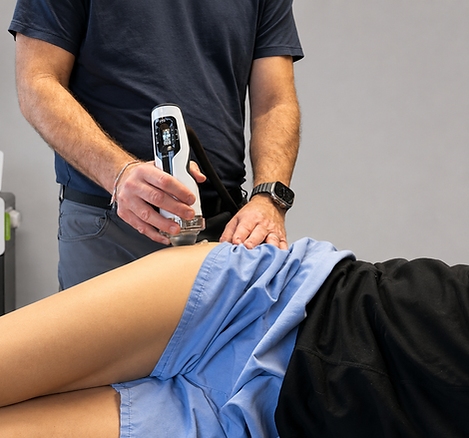
Shockwave therapy is especially effective for hip bursitis, tendinopathy of the hip flexors or glutes, and calcific deposits around the hip. The focused sound waves break up scar tissue and calcification, stimulate blood flow, and trigger the body's natural tissue repair process. It's non-invasive, requires no downtime, and works well for chronic conditions that haven't responded to rest, stretching, or injections.
Soft Tissue Therapy:
Hip pain almost always involves muscle tension and trigger points — particularly in the piriformis, glutes, hip flexors, and IT band. We use targeted soft tissue work to release these restrictions, restore normal muscle function, and reduce the pulling forces that keep the hip irritated.
We may also recommend rehabilitation exercises to help address the underlying cause of the injury or dysfunction.
The Research Behind Our Hip Pain Treatments
Our treatments are backed by peer-reviewed research. Here are key studies that inform our approach:
Acoustic wave therapy for greater trochanteric pain syndrome (hip bursitis):
Carlisi E, Cecini M, De Scala V, et al. (2016). "Focused extracorporeal shockwave therapy for greater trochanteric pain syndrome." Ultrasound in Medicine & Biology, 42(9):2024-2029. Shockwave therapy produced significant and lasting reductions in pain and disability in patients with greater trochanteric pain syndrome (the most common form of hip bursitis).
Shockwave for hip tendinopathy:
Furia JP, Rompe JD, Maffulli N. (2009). "Low-energy extracorporeal shock wave therapy as a treatment for greater trochanteric pain syndrome." American Journal of Sports Medicine, 37(9):1806-1813. Shockwave therapy demonstrated significant improvement in pain and function at 1-month and 12-month follow-up, with results superior to corticosteroid injection.
Chiropractic / manipulation for hip and pelvic pain:
Brantingham JW, Bonnefin D, Perle SM, et al. (2012). "Manipulative therapy for lower extremity conditions: update of a literature review." Journal of Manipulative and Physiological Therapeutics, 35(2):127-166. Spinal and extremity manipulation showed positive outcomes for hip osteoarthritis, hip pain, and related pelvic and lower extremity conditions.
SI joint dysfunction and chiropractic:
Kamali F, Shokri E. (2012). "The effect of two manipulative therapy techniques and their outcome in patients with sacroiliac joint syndrome." Journal of Bodywork and Movement Therapies, 16(1):29-35. Sacroiliac joint manipulation significantly reduced pain and improved function in patients with SI joint-related hip and low back pain.
Care at Thrive is provided by Dr. Tim St.Onge, DC, a board certified chiropractor with over 20 years of experience and an instructor for the Academy of Shockwave Excellence.
What to Expect at Your First Hip Pain Visit
Your first visit is focused on finding the actual source of your hip pain:
-
Health history: We ask when the pain started, where exactly it hurts, and what makes it better or worse.
-
Movement and orthopedic testing: We assess hip range of motion, strength, and which movements reproduce your symptoms.
-
Lumbar and SI joint evaluation: We check whether the spine or pelvis is contributing — frequently the case.
-
Same-day treatment: Most patients receive their first treatment at the initial visit if appropriate.
-
Your care plan: We explain what we found and give you a realistic timeline for improvement.
New patient visits typically run 30-45 minutes. No referral needed.
When This Might Not Be Right For You
We evaluate every patient carefully before recommending treatment. Situations requiring a different approach:
-
Hip fracture or acute injury requiring imaging or surgical evaluation
-
Avascular necrosis (bone death) of the femoral head
-
Active infection in or near the hip joint
-
Blood clotting disorders or patients on anticoagulant therapy
-
Active cancer in the treatment area
-
Severe neurological deficits requiring immediate specialist referral
If any of these apply, we'll tell you honestly and refer you to the right specialist.
Frequently Asked Questions About Hip Pain Treatment in
Branson, MO
Q: Can a chiropractor help with hip pain?
A: Yes — chiropractic care is effective for many types of hip pain, particularly when the hip, pelvis, sacroiliac joint, or lumbar spine are involved. A significant portion of what people experience as hip pain actually originates in the lower back or SI joint. Chiropractic adjustments address those structural causes directly, while acoustic wave therapy handles soft tissue damage in the hip itself.
Q: What is acoustic wave therapy and how does it help hip pain?
A: Acoustic wave therapy (shockwave) delivers focused sound waves into damaged or inflamed tissue. For hip conditions like bursitis, tendinopathy, and calcific deposits, it breaks up scar tissue and calcification, stimulates blood flow, and triggers the body's natural repair process. Research shows it outperforms corticosteroid injections for greater trochanteric pain syndrome (hip bursitis) at 12-month follow-up — with no side effects and no downtime.
Q: How do I know if my hip pain is coming from my back?
A: Pain that travels from the low back into the buttock, outer hip, or groin — especially if it changes with sitting or bending — often has a spinal or SI joint origin. Pain that's localized to the outer hip and worsens with lying on that side is more likely bursitis. Pain deep in the groin that worsens with hip rotation may indicate impingement or arthritis. At Thrive, we perform a full lumbo-pelvic evaluation so you don't have to guess.
Q: Is hip bursitis treatable without a cortisone shot?
A: Yes — and research suggests shockwave therapy produces better long-term results than cortisone for hip bursitis. Injections reduce inflammation quickly but don't address the underlying tissue changes; the pain often returns within months. Acoustic wave therapy stimulates actual tissue repair, making results more durable. We combine it with chiropractic to address any biomechanical factors driving the bursitis.
Q: Can chiropractic help hip arthritis?
A: Chiropractic care can meaningfully reduce pain and improve function in patients with hip osteoarthritis, even though it can't reverse the structural changes of arthritis. By improving joint alignment, reducing muscle tension, and restoring normal movement patterns, we reduce the stress on the arthritic joint — which reduces pain and slows further degeneration. Many patients with hip arthritis find they can delay or avoid surgery with consistent conservative care.
Q: What is piriformis syndrome and can you treat it?
A: Piriformis syndrome occurs when the piriformis muscle — located deep in the buttock — becomes tight or inflamed and irritates the sciatic nerve. It causes buttock pain, hip pain, and sometimes shooting pain down the leg that mimics sciatica. We treat it with soft tissue therapy to release the piriformis, chiropractic adjustments to address any pelvic misalignment contributing to the tension, and acoustic wave therapy if there is significant tissue involvement.
Q: Do you treat hip pain from IT band syndrome?
A: Yes. IT band syndrome causes pain on the outer hip and knee from a thickened, inflamed iliotibial band. It's common in runners, cyclists, and people who sit for long periods. We use soft tissue therapy and acoustic wave therapy to reduce the IT band inflammation and break up adhesions, combined with chiropractic to correct the pelvic and hip alignment issues that typically contribute to IT band problems.
Q: Do I need an X-ray or MRI before seeing you for hip pain?
A: No — you don't need imaging before your first visit. Our clinical evaluation tells us a great deal about what's happening in your hip. If we feel imaging would change our treatment approach — for example, to rule out a fracture, significant arthritis, or avascular necrosis — we'll let you know and refer you for the appropriate study. In most cases, we can begin effective treatment without it.
Learn More About Hip Pain
Hip pain can come from the joint itself, irritated tendons, the muscles around the hip, or even the lower back and pelvis. These resources can help you better understand what may be causing your pain and what treatment options may help.
Why Do I Have Pain on the Outside of My Hip? Understanding Greater Trochanteric Pain Syndrome
Pain on the outside of your hip—especially when lying on your side, climbing stairs, or getting out of a chair—may be Greater Trochanteric Pain Syndrome (GTPS). Learn why this common problem is often more than simple “hip bursitis.”
Read the Article →
https://www.thrivecfh.com/post/why-do-i-have-pain-on-the-outside-of-my-hip-understanding-greater-trochanteric-pain-syndrome
5 Things You Didn't Know Shockwave Therapy Could Do for Hip Pain
Learn how Shockwave Therapy may help address damaged tendons and other soft-tissue problems that contribute to persistent hip pain.
Read the Article →
https://www.thrivecfh.com/post/5-things-you-didn-t-know-shockwave-therapy-could-do-for-hip-pain
Why Rest Alone Doesn't Fix Tendon Injuries
Chronic hip pain often involves the gluteal tendons. Learn why rest may temporarily reduce pain without rebuilding the tendon—and why progressive rehabilitation and Shockwave Therapy may be useful for stubborn tendon problems.
Read the Article →
https://www.thrivecfh.com/post/rest-alone-doesnt-fix-tendon-injuries